
Best AI Bookkeeping Software: The Ultimate 2025 Guide to Smarter Financial Management
Everyone knows bookkeeping can be a tedious, time-consuming task for businesses.
But what exactly is the best AI bookkeeping software?
Here is your complete 2025 cheatsheet to the best AI bookkeeping software that transforms your finances.
Some are designed to automate over 90% of your accounting tasks, saving you dozens of hours per month.
Some are perfect for small businesses and startups to streamline expenses and invoicing.
Some focus on predictive analytics and financial insights to help you plan smarter.
Some integrate seamlessly with your existing systems for a smooth, connected workflow.
Some even detect fraud and ensure compliance automatically.
Let's dive right in.
Why AI Bookkeeping Matters in 2025
Bookkeeping is essential but often dreaded. Traditionally, it involved endless manual data entry, reconciliations, and error-prone calculations. These tasks drain time and resources, restricting business growth potential. Enter the best AI bookkeeping software in 2025: a game-changer for small businesses, startups, and freelancers.
AI bookkeeping software automates repetitive tasks, greatly reducing errors while speeding up processes. It empowers businesses to access real-time financial data and trends, enabling sharper decision-making. From automated invoice processing to fraud detection, AI removes bookkeeping bottlenecks, letting you focus on strategic growth.
Imagine saving 50+ hours a month, getting instant insights, and ensuring compliance—all with minimal manual input. This is the promise of AI bookkeeping. With advances in natural language processing (NLP), machine learning, and predictive analytics, today's AI tools provide comprehensive financial management like never before. (Source, Source)
Why struggle with manual bookkeeping when AI can do it smarter and faster? Here’s why the best AI bookkeeping software is worth your attention:
- Accuracy: AI reduces human errors drastically.
- Speed: Automation means faster reconciliations and reports.
- Cost-efficiency: Save on labor and outsourcing expenses.
- Real-time insights: Stay updated with live financial health snapshots.
- Scalability: Easily manage rising transaction volumes as your business grows.
- Security & compliance: Advanced detection mechanisms help avoid fraud and stay audit-ready.
These advantages are a major reason why choosing the best AI bookkeeping software has become a strategic move in 2025 for those aiming to optimize financial operations. (Verified with sources as of 2025-08-14)
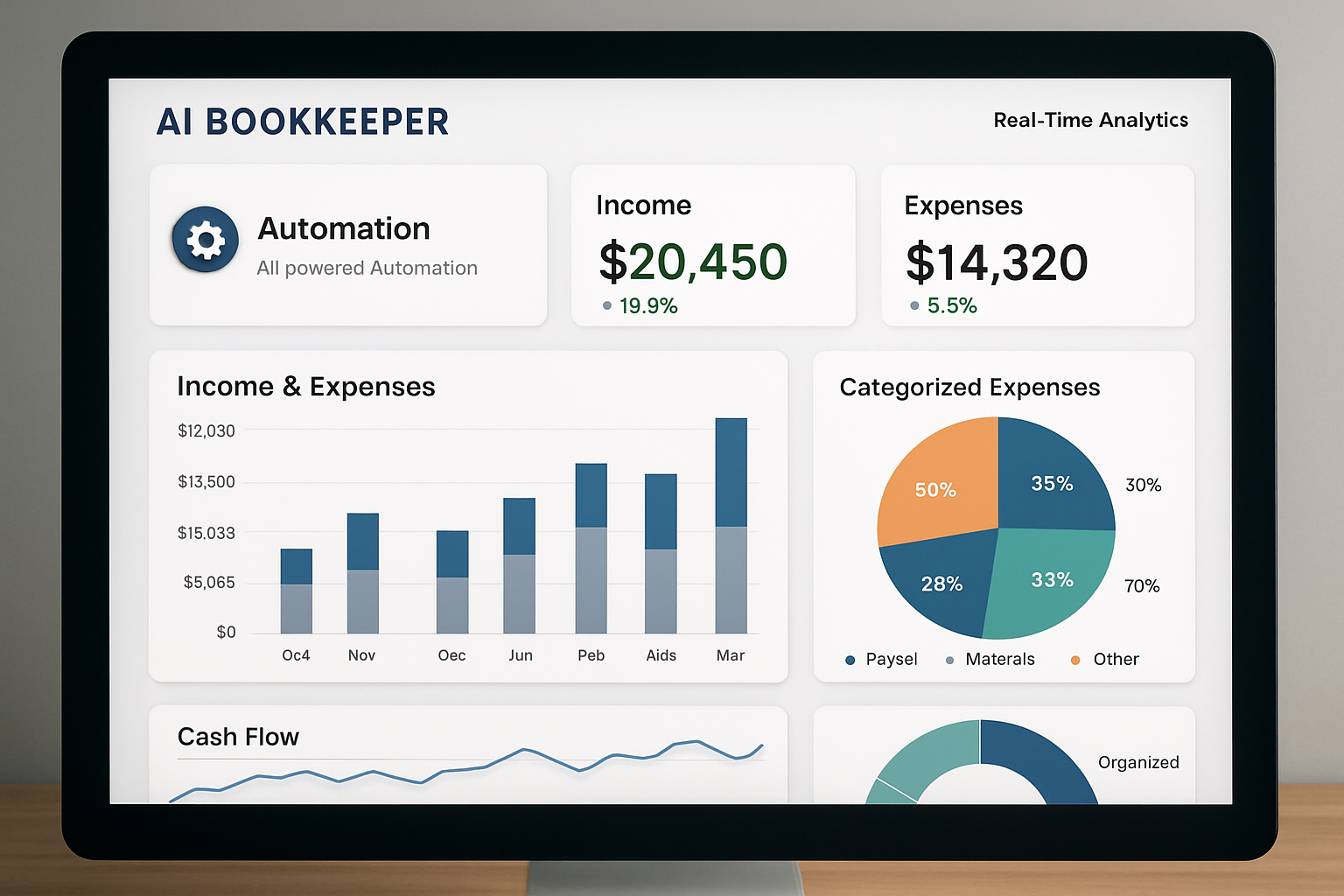
Top 5 Best AI Bookkeeping Software for 2025
Here’s an in-depth look at the top AI bookkeeping tools tailored for different business needs, budgets, and complexity levels. Each stands out for unique features and value.
1. Bookeeping.ai
Bookeeping.ai automates up to 95% of accounting tasks, saving businesses an average of 57 hours monthly. Its intuitive interface allows even novices to manage finances efficiently.
- Pricing: Starts at $50/month.
- Complexity: Easy to use for beginners.
- Features: Income/expense tracking, automated expense categorization, receipt management, and financial statement preparation.
- Free Trial: 3-day free trial available.
- User Interface: Highly rated for friendliness and simplicity.
Perfect for small businesses and freelancers who want quick automation without a steep learning curve. Source
2. Zeni
Zeni is an all-in-one financial platform designed especially for startups with end-to-end bookkeeping automation. It offers not just bookkeeping but also payroll, tax, and CFO advisory support.
- Pricing: Starts at $549/month.
- Complexity: Medium; suited for businesses willing to invest for comprehensive automation.
- Features: Automated reconciliations, invoice processing, real-time operations expenditure reports, tax credit optimization, and investor reporting.
- User Interface: Moderately friendly but powerful.
- Special Mention: Trusted by fast-growing startups to save 50+ hours monthly and streamline scaling operations.
Zeni's real-time financial visibility helped companies secure millions in funding and optimize tax benefits. Source
3. Vic AI
Vic AI specializes in automating accounts payable workflows. Its AI-driven technology extracts invoice data, validates transactions, and accelerates approvals, minimizing errors.
- Pricing: Custom pricing on contact.
- Complexity: Medium; ideal for businesses seeking automation of purchase processes.
- Features: Invoice data extraction, fraud detection, approval route streamlining.
- User Interface: Generally rated average in ease of use.
Vic AI offers significant time savings for companies dealing with high invoice volumes. Source
4. Docyt
Docyt focuses on automated expense tracking, receipt capture, and document management, simplifying compliance with taxes and regulations.
- Pricing: Starts at $299/month for back office accounting; $499 for departmental bookkeeping.
- Complexity: Medium-low; user-friendly for small to mid-size businesses.
- Features: Automated document processing, tax compliance support, reporting.
- User Interface: Moderate ratings, accessible for teams with basic accounting knowledge.
Great for companies wanting to reduce paperwork and ensure regulatory compliance. Source
5. Truewind
Truewind combines AI bookkeeping with financial management tools targeted at back office operations, budgeting, and forecasting.
- Pricing: Custom pricing on contact.
- Complexity: Medium-high; suited for businesses seeking detailed financial insights.
- Features: Automated data entry, real-time insights, budgeting assistance.
- User Interface: Moderate ease of use.
Ideal for companies wanting rich forecasting tools alongside bookkeeping. Source
Which one suits you best? It depends on your budget, business size, and financial complexity. For a deep dive on choosing the perfect AI bookkeeping software, visit our Comprehensive Guide to AI Bookkeeping Software.
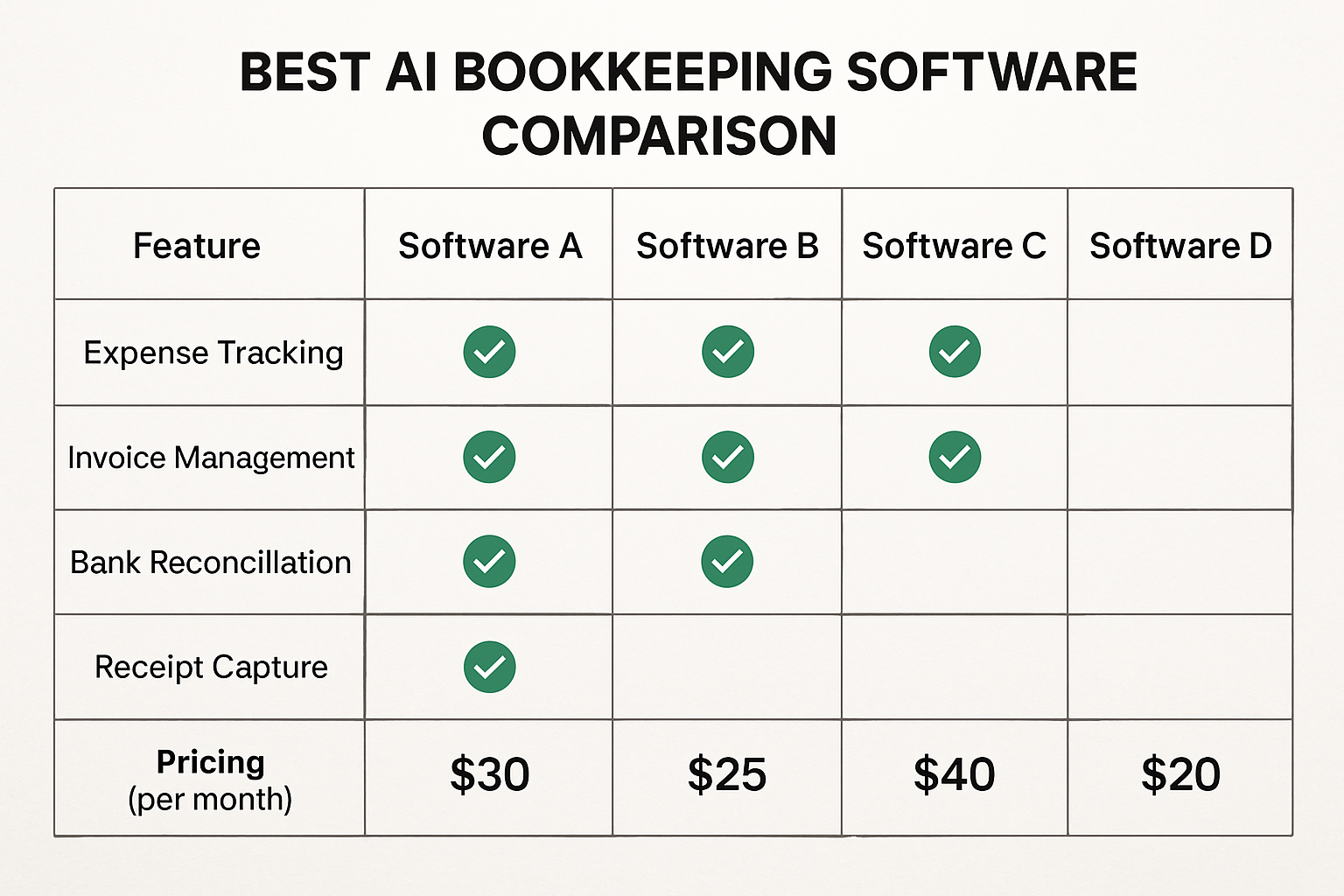
Key Features to Look for in AI Bookkeeping Software
Choosing the best AI bookkeeping software means knowing which features align with your needs. Here are key capabilities that differentiate excellent AI tools:
1. Automated Data Entry and Categorization
Machine learning algorithms scan transactions and automatically categorize expenses and incomes. This saves hours and improves accuracy by reducing manual input errors.
2. Invoice and Receipt Processing
Natural language processing enables AI to read and extract important details from invoices and receipts. This streamlines accounts payable and expense reporting.
3. Reconciliation Automation
AI-powered reconciliation compares bank statements to recorded transactions, identifying discrepancies rapidly and suggesting corrections.
4. Predictive Analytics and Forecasting
Advanced AI engines analyze historical data to project future cash flow, budget needs, and financial trends for strategic planning.
5. Fraud Detection and Compliance
Behavioral algorithms detect anomalies or suspicious transactions to prevent fraud. Automated monitoring ensures adherence to tax laws and regulations.
6. Real-Time Financial Dashboards
Access up-to-date reports, profit and loss statements, and key metrics on customizable dashboards to keep your finger on the pulse.
7. Seamless Integration
Top AI bookkeeping software integrates with other business platforms like payment processors, CRM, ERP, and payroll systems for smooth workflow.
8. User-Friendly Interface and Support
A clean UI and strong customer support make onboarding faster and help teams adapt quickly.
Want to automate bookkeeping and boost efficiency? Learn how to automate bookkeeping effectively with expert strategies and tools.
How AI Improves Financial Management for Small Businesses
AI bookkeeping redefines financial management beyond just automating tasks. Let’s breakdown how small businesses benefit profoundly from AI’s capabilities.
Accuracy and Error Reduction
Manual bookkeeping is prone to misentries, transposed digits, and overlooked transactions. AI systems learn from vast transaction data, continuously minimizing errors and catching inconsistencies early. This builds trust in financial reports and smooths tax audits.
Time Savings and Focus on Growth
By automating data entry, reconciliations, and reporting, AI frees business owners from bookkeeping drudgery. Now, entrepreneurs can devote their precious hours to revenue-generating operations or customer engagement.
Cost Efficiency
Reducing reliance on expensive manual labor or outsourcing bookkeeping saves significant money. AI reduces compliance penalties by ensuring accuracy and timely filings.
Real-Time Insights and Strategic Decisions
Traditional bookkeeping reports often come weeks late. AI delivers instant dashboards showing cash flow status, expense trends, and profit margins. This empowers proactive decision-making—important in volatile markets.
Fraud Prevention and Data Security
AI analyses spending patterns to flag unusual transactions, preventing fraud before damage occurs. Encrypted AI platforms protect sensitive financial data from breaches.
Customized Solutions for Industry Needs
AI adjusts to unique industries—retail, manufacturing, services—delivering tailored insights and compliance tracking specific to your sector’s requirements. Source

Did you know? Businesses that adopt AI bookkeeping report 30% faster financial close periods and reduced audit errors. How can your business leverage such gains?
Choosing the Right AI Bookkeeping Software for Your Business
It’s tempting to pick based on hype or lowest price, but a smart choice depends on your unique circumstances. Consider these factors:
1. Business Size and Complexity
Small freelancers may want affordable, simple tools like Bookeeping.ai. Growing startups with complex needs may prefer Zeni or Truewind’s advanced features.
2. Budget Constraints
Evaluate total cost including subscriptions and implementation. Factor in cost savings from automation to calculate ROI. Sometimes higher upfront costs pay off with time saved. Check out how to calculate ROI.
3. Feature Priority
Decide what matters most: invoice automation, cash flow forecasting, fraud detection, seamless integrations? Match software capabilities accordingly.
4. Integration with Current Systems
Ensure the AI bookkeeping software syncs effortlessly with your CRM, ERP, and payroll platforms to avoid data silos.
5. Ease of Use and Support
Choose solutions with intuitive interfaces and responsive support to minimize training time and disruption.
6. Future Scalability
Your ideal software will grow with your business, adding features or capacity as needed without forcing costly migrations.
With the right investment, your bookkeeping tool becomes a strategic partner, not just software. It’s worth spending time to research and even trial options.
Future Trends in AI Bookkeeping
The AI bookkeeping landscape in 2025 is dynamic, with exciting innovations on the horizon promising even greater value.
Enhanced Predictive Analytics
AI capabilities will deepen financial forecasting, offering tailored budgeting advice and early warnings of cash crunches.
Deeper System Integration
Expect smoother connections with CRM, ERP, tax, and payroll software to create a unified financial ecosystem.
Improved Fraud Detection
More sophisticated algorithms will identify subtle anomalies early, protecting companies proactively.
Expanded Automation Scope
AI will handle even more complex tasks like multi-entity consolidations and international compliance tracking.
Personalized Financial Advisory
Bookkeepers and CFOs will leverage AI to offer bespoke insights, moving beyond basic bookkeeping into strategic finance partners. Source
Keeping abreast of these trends ensures your business leverages AI continuously to stay competitive.
Conclusion and Next Steps
The best AI bookkeeping software in 2025 unlocks incredible efficiencies and easy access to accurate financial information. It revolutionizes how businesses handle accounting: faster, smarter, and with less hassle.
From AI-powered automation of invoices and reconciliations to predictive analytics and fraud detection, these tools represent a strategic advantage in today’s business landscape.
Don’t let outdated manual bookkeeping hold you back. Evaluate your needs against the top tools we outlined and consider trying free trials like Bookeeping.ai or demos from Zeni.
Investing in AI bookkeeping software saves time, reduces costs, improves compliance, and enhances your financial decision-making capabilities. As the future unfolds, AI will only become more integral to successful business finance management.
Ready to elevate your bookkeeping with the best AI solutions? Start by exploring detailed software reviews and step-by-step guides to mastering automation, such as Mastering Bookkeeping Automation.
And remember, for personalized recommendations and help optimizing your financial workflows, outsourced bookkeeping services can expertly integrate AI and improve your bookkeeping outcomes.
What's Your Next Step?
Tell us in the comments: How will you apply this to your financial management? For personalized advice, contact us!
Also, if you want expert insights beyond bookkeeping, check out Home Loan Broker Perth's comprehensive guide for financing your property investments and planning your financial future effectively.