Bookkeeping Automation Software: The Ultimate 2025 Guide for Effortless Finance Management
Bookkeeping automation software has revolutionized how businesses manage their finances.
But what is bookkeeping automation software, exactly?
Here’s a complete 2025 cheatsheet to master bookkeeping automation software.
Some are basic tools that help with simple transaction recording.
Some are AI-powered platforms that predict trends and suggest improvements.
Some are specialized for e-commerce, integrating seamlessly with sales channels.
Some save hours on tedious reconciliations and reduce costly mistakes.
Some grow with your business, adapting to increasing complexity and volume.
Let's dive right in.
Table of Contents
- What Is Bookkeeping Automation Software?
- Key Benefits of Automated Bookkeeping
- Top Features to Look For in Bookkeeping Automation Software
- Popular Bookkeeping Automation Software Options in 2025
- Real-World Use Case: Etsy Xero Integration
- Implementing Automated Bookkeeping Software Successfully
- Overcoming Common Challenges
- Future Trends in Bookkeeping Automation
- Conclusion and Next Steps
What Is Bookkeeping Automation Software?
At its core, bookkeeping automation software uses technology to handle traditional bookkeeping tasks with minimal manual input. This includes recording transactions, categorizing expenses, reconciling accounts, and generating financial reports.
Instead of manually entering receipts and invoices, these tools connect directly to your bank accounts, credit cards, and business platforms. They automatically fetch transaction data and apply rules to classify and reconcile it accurately.
Imagine going from sorting through mountains of paper to having up-to-date financials delivered automatically to your dashboard — that’s the power of bookkeeping automation software.
Not all software is one-size-fits-all. Some focus on small business needs with simple interfaces, while others offer multi-entity support, advanced analytics, or industry-specific features, especially for ecommerce and service-based businesses.
Why does this matter? Because accounting inaccuracies and delays can cost businesses money and opportunity. Automated solutions help reduce errors and free up your time for strategic decisions, rather than data entry.
Key Benefits of Automated Bookkeeping
Switching to bookkeeping automation software offers transformative advantages beyond just convenience.
- Time Savings: Automation converts hours or days of manual bookkeeping into minutes or even seconds. Tasks like data entry, transaction matching, and reconciliation run in the background without human intervention. As ecommerce seller Parag, CEO of Webgility, notes, what once took days can become minutes, allowing businesses to focus on marketing or product development [source].
- Accuracy and Reduced Errors: Manual processes inevitably lead to errors—typos, missed transactions, wrong calculations. Automated software virtually eliminates these pitfalls, improving audit readiness and reducing costly mistakes [source].
- Real-Time Financial Insights: Instant access to up-to-date financial data empowers owners and finance teams to make proactive choices. For example, knowing your cash flow trends, top-selling products, or profit margins at a glance can be transformational [source].
- Improved Compliance and Tax Handling: Automated categorization helps with easier preparation of tax returns, sales tax calculations, and meeting regulatory requirements accurately [source].
- Scalability: Businesses grow; bookkeeping needs get more complex. Automation solutions can scale to handle higher transaction volumes, multiple sales channels, multi-currency issues, and additional users [source].
Are you wondering how to leverage those benefits for your business? Keep reading, because next, we'll break down the must-have features you should seek when evaluating software options.
Top Features to Look For in Bookkeeping Automation Software
Choosing the right bookkeeping automation software can be overwhelming. Here’s a comprehensive list of features that can elevate your financial management:
- Bank & Credit Card Integration: Look for software that securely connects to multiple institutions and imports data automatically. This is foundational for reducing manual input.
- Automatic Categorization and Expense Tracking: A good tool uses intelligent rules or AI to classify transactions reliably, reducing your categorization workload.
- Invoice Automation: Generates and sends professional invoices automatically, with payment reminders to speed up receivables.
- Bank Reconciliation: Matches transactions against bank statements to keep accounts accurate and up-to-date.
- Multi-Channel Sales and Inventory Sync: If you sell on platforms like Etsy, Shopify, or Amazon, syncing sales and inventory data prevents errors and stockouts.
- Multi-Currency Support: Ideal for international sellers, this feature automates currency conversion and maintains accurate profitability metrics.
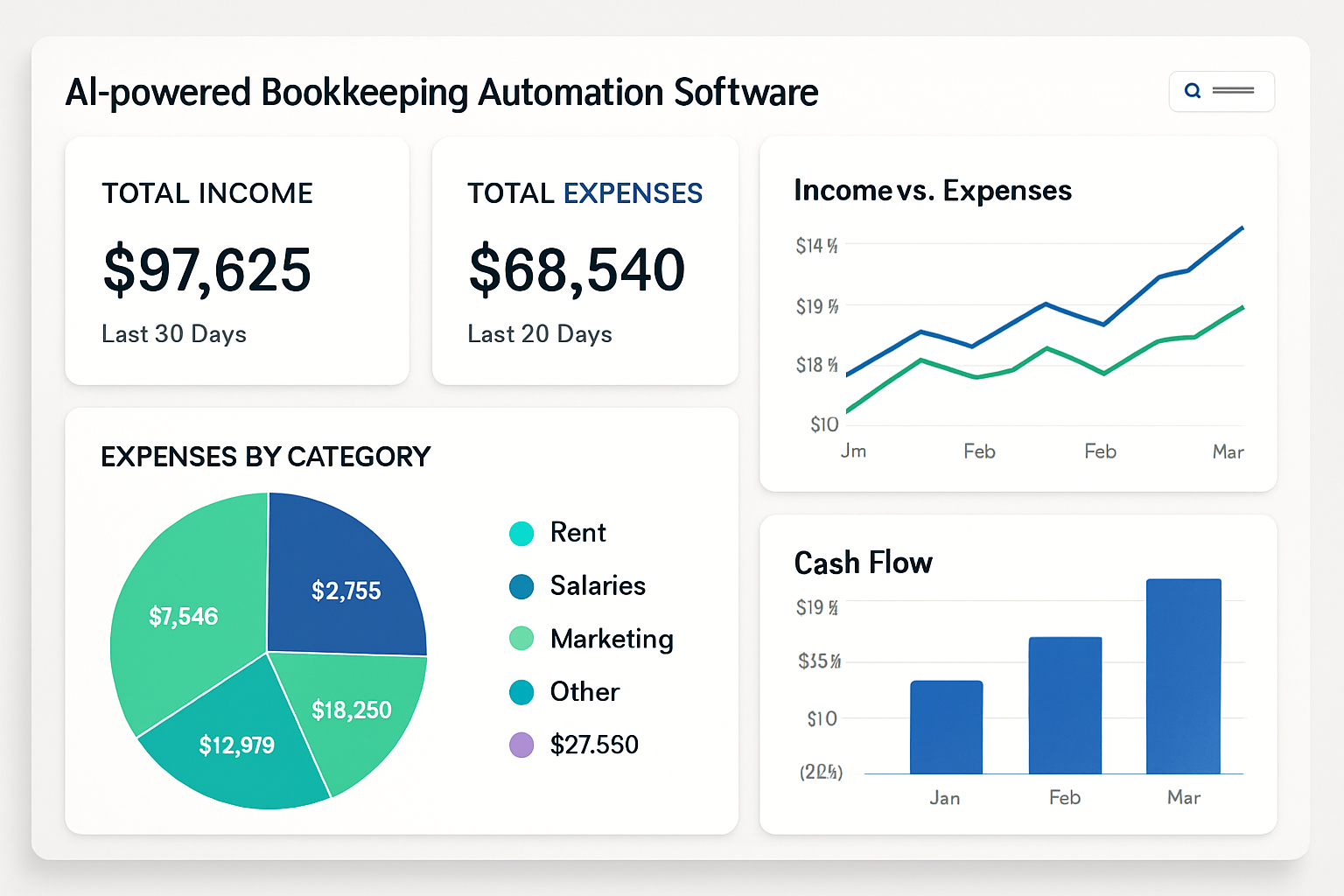
- Robust Reporting & Analytics: Generates profit & loss statements, balance sheets, cash flow reports, and custom dashboards with KPIs.
- Tax Compliance Tools: Automated sales tax calculations, tax category mapping, and integration with tax filing services.
- User-Friendly Interface & Support: Intuitive navigation plus responsive customer service and training resources significantly ease onboarding.
- Security and Data Privacy: Ensure the vendor follows industry best practices like encryption, secure cloud storage, and compliance with data regulations.
If you're running a specialized business—say, ecommerce or freelance services—look for software tailor-made for your industry to get maximum value.
Popular Bookkeeping Automation Software Options in 2025
The software landscape continues to evolve rapidly. Here are some standout solutions for 2025, acclaimed for their features, ease of use, and customer satisfaction.
QuickBooks Online
Often the first name that comes to mind, QuickBooks Online offers comprehensive bookkeeping automation with unlimited invoicing, expense tracking, and bank connections. Its scalability fits small to mid-sized businesses, and many users praise its robust ecosystem and mobile app [source].
Xero
Known for affordability and a clean interface, Xero excels in automatic bank feeds, collaboration features, and multi-currency handling. Ideal for freelancers and small businesses, it's also enhanced by integrations with platforms like Etsy, especially with tools such as Webgility that simplify ecommerce bookkeeping [source].
FreshBooks
FreshBooks is designed with non-accountants in mind, providing automated invoicing and expense reconciliation. Its intuitive UI and helpful customer service make it a perfect starter solution for solopreneurs and small teams [source].
Sage Business Cloud Accounting
Great for micro-businesses, Sage blends affordability with solid automation features and financial reporting, helping new entrepreneurs get a handle on their books with minimal fuss.
Ramp
A newer entrant focusing on spend management, Ramp offers automation tools to track, organize, and manage company expenses effortlessly. Its free-to-use model is attractive to budget-conscious startups [source].
These options represent just a fraction of the available software out there. When choosing, prioritize solutions aligned with your business size, industry, and growth plans.
Real-World Use Case: Etsy Xero Integration
Etsy sellers face unique financial management challenges. Etsy deposits don’t always mirror sales exactly due to marketplace holds and fees. Manually syncing and reconciling these transactions can become a nightmare.
The beauty of bookkeeping automation software emerges when combined with seamless integrations like Etsy and Xero. This setup automates data transfer—sales, fees, refunds, and taxes flow directly into accounting software daily or in real-time, clearing up discrepancies and speeding reconciliation [source].
Tools like Webgility bridge this gap effortlessly, handling multi-currency issues, inventory updates, and cost of goods sold calculations for profitability insights. With such automation:
- Manual entry errors vanish.
- Business insights are just a click away.
- Tax filing prep becomes smoother and less stressful.
Pro tip: Use test syncs and continuous monitoring to ensure data integrity and adapt to business growth or seasonal surges [source].

Have you considered how integrations could minimize your manual workload? The right sync tool might be your ticket to a more profitable and less stressful business.
Implementing Automated Bookkeeping Software Successfully
Adopting new software is a big step. Here is a detailed 7-step approach for smooth implementation, improved adoption, and maximizing benefits [source]:
- Assess Current Processes: Identify manual pain points — invoice handling, bank reconciliation delays, or reporting gaps.
- Define Goals: Be clear whether you want more accuracy, faster closes, better compliance, or all the above.
- Select the Right System: Choose software fitting your business size, industry needs, and budget.
- Implementation Planning: Create timelines, allocate resources, and engage stakeholders from finance to IT.
- Data Migration: Clean and audit your existing financial data before importing to ensure accuracy.
- Training & Change Management: Invest in comprehensive training and communicate benefits clearly to overcome resistance.
- Testing and Continuous Monitoring: Pilot test workflows, identify issues pre-launch, and monitor ongoing performance for improvements.
Keep in mind: no system is magic. Effective usage requires ongoing management and periodic reviews — but the ROI makes it worthwhile.
Overcoming Common Challenges
Transitioning to automated bookkeeping software can present hurdles. Here’s how you can preempt or address them:
- Resistance to Change: People worry about job security or adapting to new tech. Build a culture of learning, emphasize time savings, and provide hands-on support.
- Data Migration Pitfalls: Inaccurate data can cause major headaches. Run data audits and use automated migration tools where possible.
- Integration Complexities: Connecting new software with existing ERP, CRM, or sales platforms can be tricky. Collaborate closely with IT and leverage vendor expertise.
- Initial Investment Costs: The upfront expense can be daunting. However, consider long-term savings from time reclaimed and errors avoided.
- Compliance Concerns: Ensure chosen software has robust tax and accounting compliance features and is regularly updated.
Jason Kyle Berwanger, a finance and tech leader, sums it up: "Automated bookkeeping software pays for itself by freeing your team for strategic, high-value tasks rather than drowning in manual entries." [source].
Future Trends in Bookkeeping Automation
Exciting advancements are shaping the future of bookkeeping automation software, promising even smarter financial management tools:
- Artificial Intelligence and Machine Learning: Going beyond data entry, AI will analyze transaction patterns, predict cash flows, and suggest optimization strategies—think of it as a virtual CFO assistant [source].
- Blockchain Integration: Offering secure, immutable ledgers for transactions, this will reduce fraud risk and improve audit trails, especially for crypto and international businesses [source].
- Predictive Analytics: Automated systems increasingly forecast financial trends, giving businesses foresight to make proactive decisions [source].
- Hyperautomation: Combining RPA (robotic process automation), AI, and analytics to fully streamline accounting workflows, from onboarding clients to final reports [source].
These innovations signal a future where bookkeeping automation software not only saves time but also becomes a strategic partner in growing your business.
Conclusion and Next Steps
The landscape of bookkeeping automation software offers immense opportunities for businesses aiming to improve efficiency, accuracy, and insights.
From small startups to established ecommerce sellers, implementing the right automated solution can unlock hours of time, reduce expensive errors, and provide a clear real-time picture of financial health.
Begin with assessing your unique bookkeeping challenges, prioritize must-have features, and test software options through demos or trials.
Consider platforms like QuickBooks, Xero, or specialized integrators like Webgility for ecommerce sellers—each caters to different needs and budgets.
Implementation requires thoughtful planning, comprehensive training, and ongoing monitoring to reap the full benefits.
For a deeper dive into strategies and technologies that elevate bookkeeping workflows, explore The Ultimate 2025 Guide to Accounting Workflow Automation.
Ready to see bookkeeping automation software revolutionize your business finances?
What's Your Next Step?
Tell us in the comments: How will you apply bookkeeping automation software to transform your financial workflows? For personalized advice, contact us!
Also, check out the creative ways to energize your entire team's collaboration in 50+ Creative Workshop Ideas to Inspire and Engage Your Team as you streamline your bookkeeping automation journey.